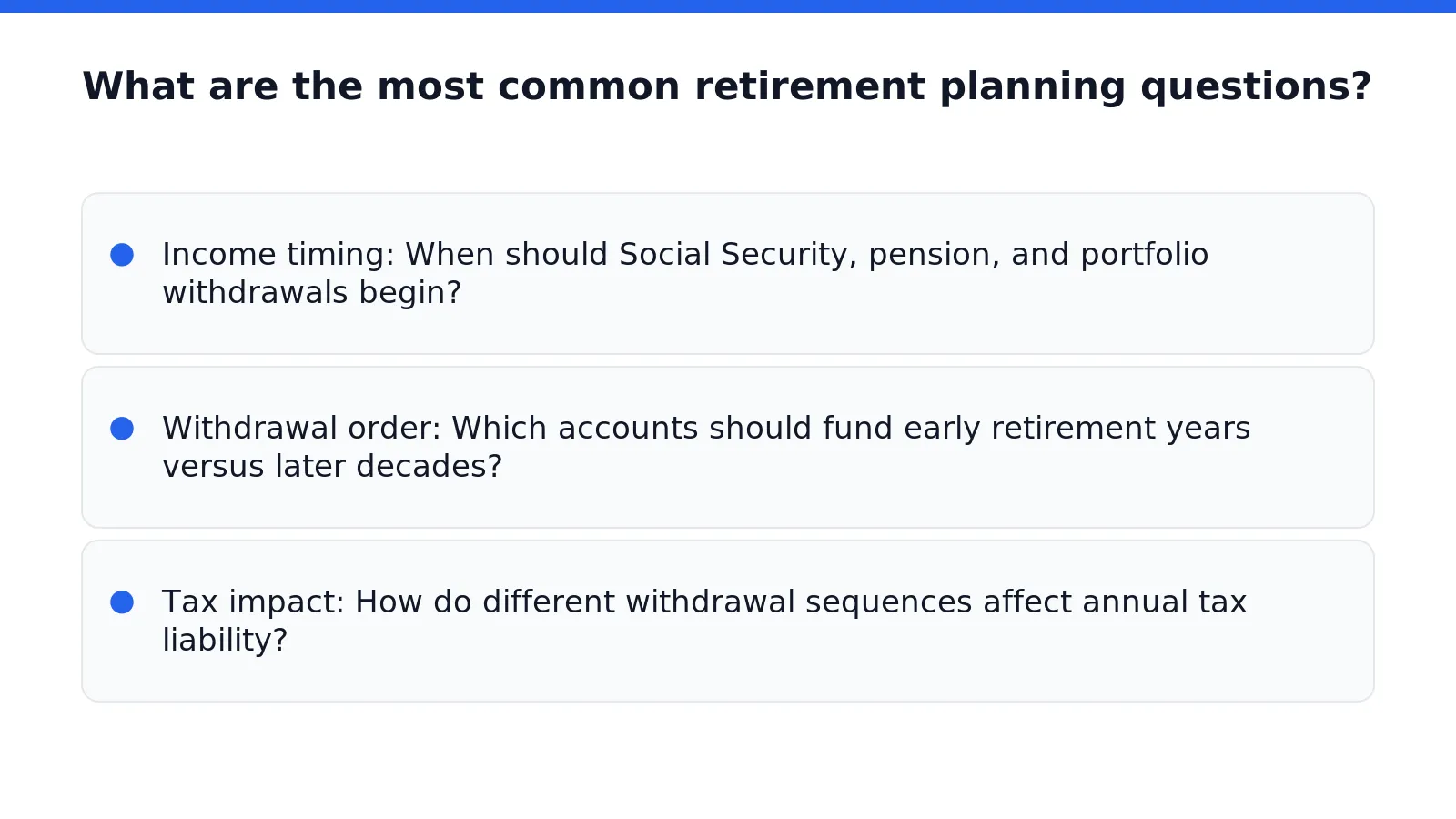


Protecting retirement income requires a layered strategy balancing withdrawals, growth, and risk protection. A common guideline is the 4% rule, withdrawing less than 4% of a portfolio in year one, then adjusting for inflation annually. Conservative planners today often suggest 3–3.5% for greater safety with longer lifespans.
Key Takeaways
- Longevity risk threatens every retirement plan as lifespans increase and portfolios must stretch across 25 to 30 years.
- Withdrawing less than 4% of a portfolio in year one, then adjusting for inflation annually, provides a sustainable withdrawal framework.
- Delaying Social Security benefits past full retirement age permanently increases the monthly payment, creating a larger inflation-adjusted income base.
- A guaranteed income stream removes the need to sell assets during market downturns to cover essential living expenses.
What is longevity risk and why does it matter?
Longevity risk is the danger of outliving retirement savings, a growing concern as lifespans increase. Retirement savings may need to last 25 to 30 years or more. That extended timeline makes longevity risk a central planning challenge for pre-retirees and recent retirees.
The stakes are concrete. A retiree who exhausts savings at age 82 faces over a decade of uncertainty if planning to age 95. Planning to at least age 90 to 95 is wise, according to retirement finance research. Without a deliberate strategy, the final years of retirement become financially fragile.
Why does longevity risk catch retirees off guard?
Longevity risk compounds quietly. Three factors drive the problem:
- Withdrawal pressure: Regular income needs drain principal faster than many expect.
- Inflation erosion: Purchasing power shrinks each year, even with modest inflation.
- Market volatility: A downturn early in retirement accelerates portfolio depletion.
A coordinated plan unites income, growth, and legacy strategies to address longevity risk. Clients gain clarity on how long their assets can realistically last.
How can retirees protect against longevity risk?
Longevity protection strategies start with honest planning. Retirees can evaluate guaranteed income for life options alongside growth assets. The goal is simple: income that continues regardless of market conditions or lifespan.
For a deeper look at how to avoid outliving savings, Jacobs Financial Services offers guidance on minimizing retirement risk through capital-preservation strategies. The company’s approach prioritizes protection from market risk while maintaining purchasing power.
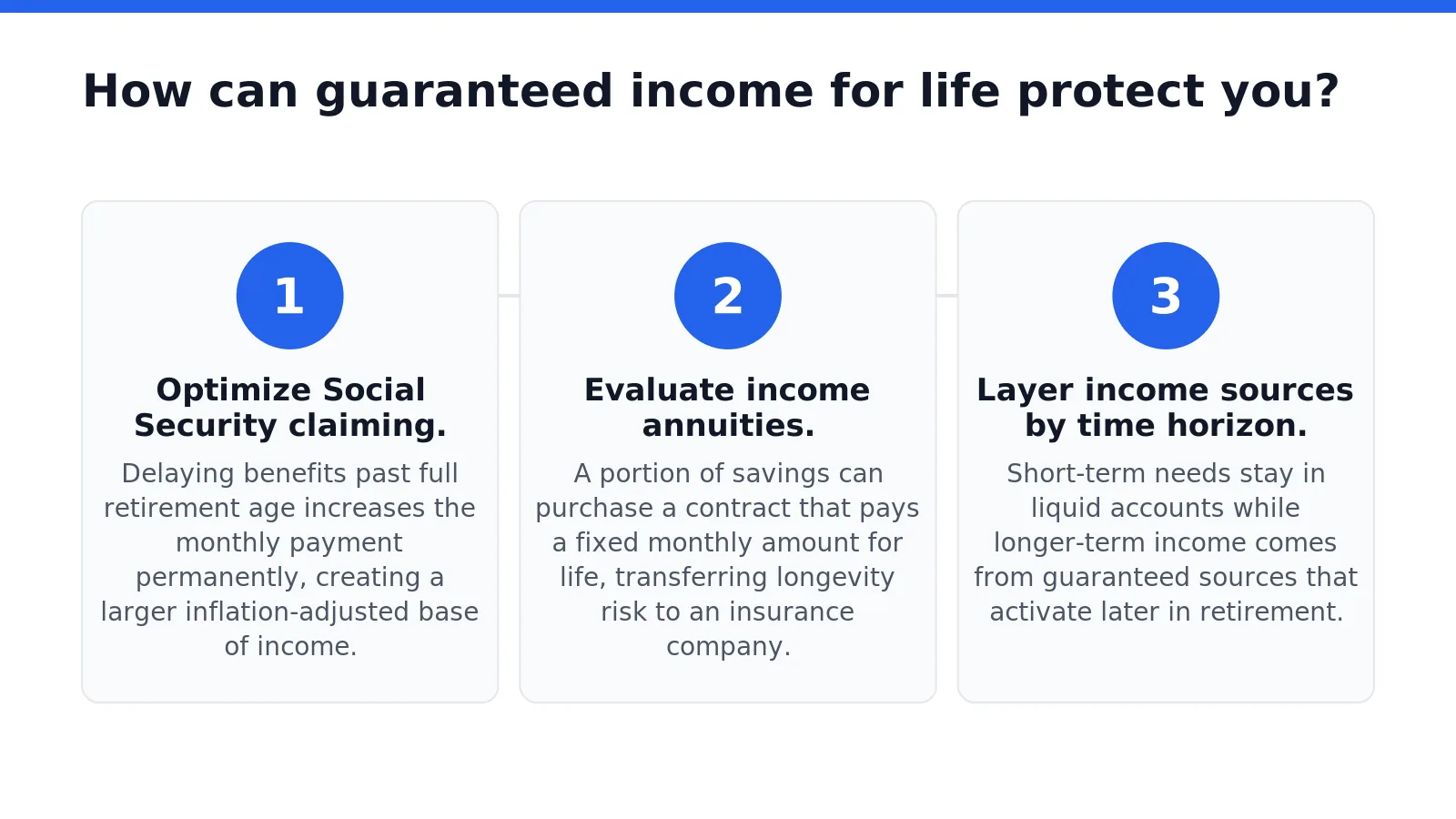
How can guaranteed income for life protect you?
Guaranteed income for life shields retirees from the financial devastation of outliving their assets. A dependable income stream converts a finite portfolio into a permanent paycheck that continues regardless of market conditions or lifespan.
Longevity risk threatens every retirement plan. People routinely underestimate how long they will live, and a portfolio that must stretch across 25 to 30 years faces relentless pressure from inflation and spending shocks. Without a floor of predictable income, even a well-funded account erodes faster than expected.
Jacobs Financial Services addresses this vulnerability through the Jacobs Retirement Roadmap™. The process prioritizes protection from market risk so accumulated wealth stays intact while generating consistent cash flow. Rather than chasing growth that exposes principal to downturns, the company structures dependable income strategies that minimize risk and build reliable income streams.
What types of guaranteed income work best for retirement?
Several vehicles deliver guaranteed income for life, and the right mix depends on a retiree’s specific situation.
- Optimize Social Security claiming. Delaying benefits past full retirement age increases the monthly payment permanently, creating a larger inflation-adjusted base of income.
- Evaluate income annuities. A portion of savings can purchase a contract that pays a fixed monthly amount for life, transferring longevity risk to an insurance company.
- Layer income sources by time horizon. Short-term needs stay in liquid accounts while longer-term income comes from guaranteed sources that activate later in retirement.
How does guaranteed income reduce market risk?
Market losses in the early years of retirement inflict disproportionate damage on a portfolio’s survival. A guaranteed income stream removes the need to sell assets during downturns to cover living expenses. Jacobs Financial Services integrates this protection directly into its planning framework, ensuring that essential costs are covered by stable sources before any growth-oriented allocation is considered. This approach keeps hard-earned money safe from sequence-of-returns risk while still supporting a comfortable lifestyle.
Creating a reliable retirement income stream requires coordinating these elements into one cohesive plan. The goal is not simply accumulating a large number but structuring assets so they produce income that outlasts any reasonable lifespan.

What withdrawal rate helps avoid outliving savings?
A sustainable withdrawal rate determines how much a retiree can spend annually without depleting assets too soon. The widely cited 4% rule provides a starting framework, though conservative planners now recommend lower percentages for stronger longevity protection strategies.
The 4% rule originates from retirement finance research. It directs a retiree to withdraw less than 4% of the total portfolio in the first year of retirement. Each subsequent year, that dollar amount adjusts upward to match inflation. This method aims to sustain a portfolio across a 30-year retirement horizon.
How does the 4% rule work in practice?
The following year, the withdrawal increases by the inflation rate, not by a fixed percentage of the remaining balance. This structure provides predictable income while allowing the portfolio to continue growing.
Why do conservative planners suggest a lower rate?
Longer lifespans and unpredictable market conditions make the original 4% figure less reliable for some households.
Jacobs Financial Services addresses this challenge through inflation-fighting strategies that help purchasing power remain steady. The company’s approach integrates market risk protection with withdrawal planning, so retirees do not sacrifice security for income.
|—————–|————————–|—————–|
Is the 4% rule still relevant today?
The 4% rule remains a useful benchmark, but it requires adjustment for individual circumstances. A deeper look at the 4% rule’s relevance for today’s retirees reveals how inflation and market volatility reshape its application. Retirees who pair a conservative withdrawal rate with guaranteed income for life components reduce the danger of outliving their assets.
How do you guard against sequence-of-returns risk?
Sequence-of-returns risk threatens retirement savings when poor market returns strike early in retirement. Early losses deplete a portfolio faster than expected, leaving less capital to recover when markets rebound. Jacobs Financial Services addresses this danger through deliberate market risk protection.
The company structures retirement assets so hard-earned money stays safe during volatile periods. This protective approach reduces the damage that early-retirement downturns inflict on long-term savings.
What is the safest withdrawal approach for early retirement?
A bucket strategy separates short-term cash needs from long-term growth assets. Clients keep near-term spending in stable holdings while growth investments remain untouched for later years. This time-segmentation method prevents forced selling during market declines.
How does Jacobs Financial Services reduce early-retirement market exposure?
Jacobs Financial Services emphasizes protection from market risk as a core planning principle. The company helps clients avoid the worst effects of early-retirement market downturns through structured safeguards. Retirees gain confidence knowing their savings carry defensive positioning.
To guard against sequence-of-returns risk, follow these steps:
- Separate assets into time-based buckets. Allocate cash for the first three to five years of retirement into low-volatility holdings.
- Protect growth assets from early withdrawals. Leave long-term investments untouched during initial retirement years.
- Apply market risk protection strategies. Work with Jacobs Financial Services to shield savings from downturns.
- Review withdrawal timing annually. Adjust distributions based on current market conditions and portfolio performance.
The Brookings Institution notes that uncertain investment returns rank among the primary threats to retirees’ financial security. Jacobs Financial Services counters this uncertainty through its sequence-of-returns risk planning framework. Clients receive a structured defense against the timing hazards that erode retirement income.
What role do health care costs play in longevity risk?
Health care costs represent a primary driver of longevity risk. Higher-than-expected medical spending accelerates the depletion of retirement savings, threatening financial security for pre-retirees and recent retirees. A Brookings Institution analysis identifies uncertain investment returns, higher-than-expected inflation, and the chance of facing high out-of-pocket health expenses as major threats to retirees’ financial security. These costs compound over decades, turning a manageable budget into a shortfall.
How do medical expenses affect retirement savings over time?
Medical expenses rise sharply in later years. Planning for health care costs is a critical component of longevity protection strategies. The Genworth Cost of Care Survey documents this upward trend, showing that long-term care services consume an increasing share of household income as retirees age. Without dedicated planning, these costs force premature portfolio withdrawals. Each unplanned expense shrinks the principal that generates future income.
What happens when health costs are ignored in a retirement plan?
Ignoring health care projections creates a dangerous gap. A retirement strategy that omits medical inflation and long-term care needs leaves retirees exposed to catastrophic spending. Jacobs Financial Services addresses this vulnerability through legacy and long-term care planning. The company helps clients structure their assets so they can leave behind more than memories. Early preparation for long-term care needs prevents rushed decisions during health crises and preserves retirement independence.
How can retirees protect savings from health care cost risk?
Protection begins with realistic cost projections and dedicated funding. A guaranteed income for life strategy paired with long-term care provisions shields core retirement assets. Jacobs Financial Services integrates these elements into a cohesive plan. The approach focuses on market risk protection and inflation-fighting strategies, ensuring purchasing power remains strong even as medical bills mount. Addressing health care costs directly transforms longevity risk from a silent threat into a managed variable.
FAQ
What is the 4% rule for retirement withdrawals?
The 4% rule is a guideline suggesting retirees withdraw 4% of their portfolio in the first year of retirement, then adjust that dollar amount for inflation each subsequent year. It originated from research on sustainable withdrawal rates over a 30-year retirement horizon.
What is the Jacobs Retirement Roadmap™?
The Jacobs Retirement Roadmap™ unites income, growth, and legacy strategies into one coordinated plan to address longevity risk.
Conclusion
Protecting against outliving your retirement savings requires a strategy that addresses market risk, inflation, and health care costs together. A coordinated plan that pairs conservative withdrawal rates with guaranteed income and long-term care provisions transforms longevity risk from a silent threat into a managed variable. The next step is reviewing your current approach to ensure it includes these protective elements.