


When it comes to retirement glossary, retirement planning glossary terms include 401(k) plans, annuities, and asset allocation. A 401(k) is an employer-sponsored account with pre-tax contributions and IRS-set limits. An annuity provides regular income, often for life. Asset allocation distributes investments across asset classes to manage risk and align with retirement goals.
Key Takeaways
- A 401(k) is an employer-sponsored account funded with pre-tax payroll deductions.
- Employer matching provides additional compensation toward retirement contributions.
- Dollar-cost averaging invests fixed amounts regularly, buying more shares when prices decline.
- Asset allocation drives the majority of a portfolio’s risk and return profile.
What is a retirement glossary and why do you need one?
A retirement glossary is a curated collection of retirement planning definitions that translates complex financial language into clear, understandable terms. A retirement terms glossary serves as a practical reference tool, helping individuals assess their options with greater confidence. Without this clarity, pre-retirees risk making decisions based on incomplete understanding of the accounts and strategies that shape their future.
How does a financial planning glossary help with decision-making?
A financial planning glossary breaks down the mechanics behind common vehicles like 401(k) plans, annuities, and required minimum distributions. Navigating the countless industry terms encountered during planning often proves difficult. Understanding the different aspects associated with retirement accounts allows for better evaluation of income strategies and tax implications.
What role does an annuity glossary play in protecting retirement income?
An annuity glossary clarifies the contractual features that turn savings into guaranteed lifetime income. Jacobs Financial Services structures strategies around protection from market risk and inflation-fighting measures. Knowing the precise meaning of terms like accumulation phase, annuitization, and exclusion ratio helps retirees determine whether a contract aligns with their need for safety and purchasing power preservation. A brief retirement readiness quiz offers a starting point for assessing personal preparedness.
What are the key retirement terms glossary definitions for 401(k) plans?
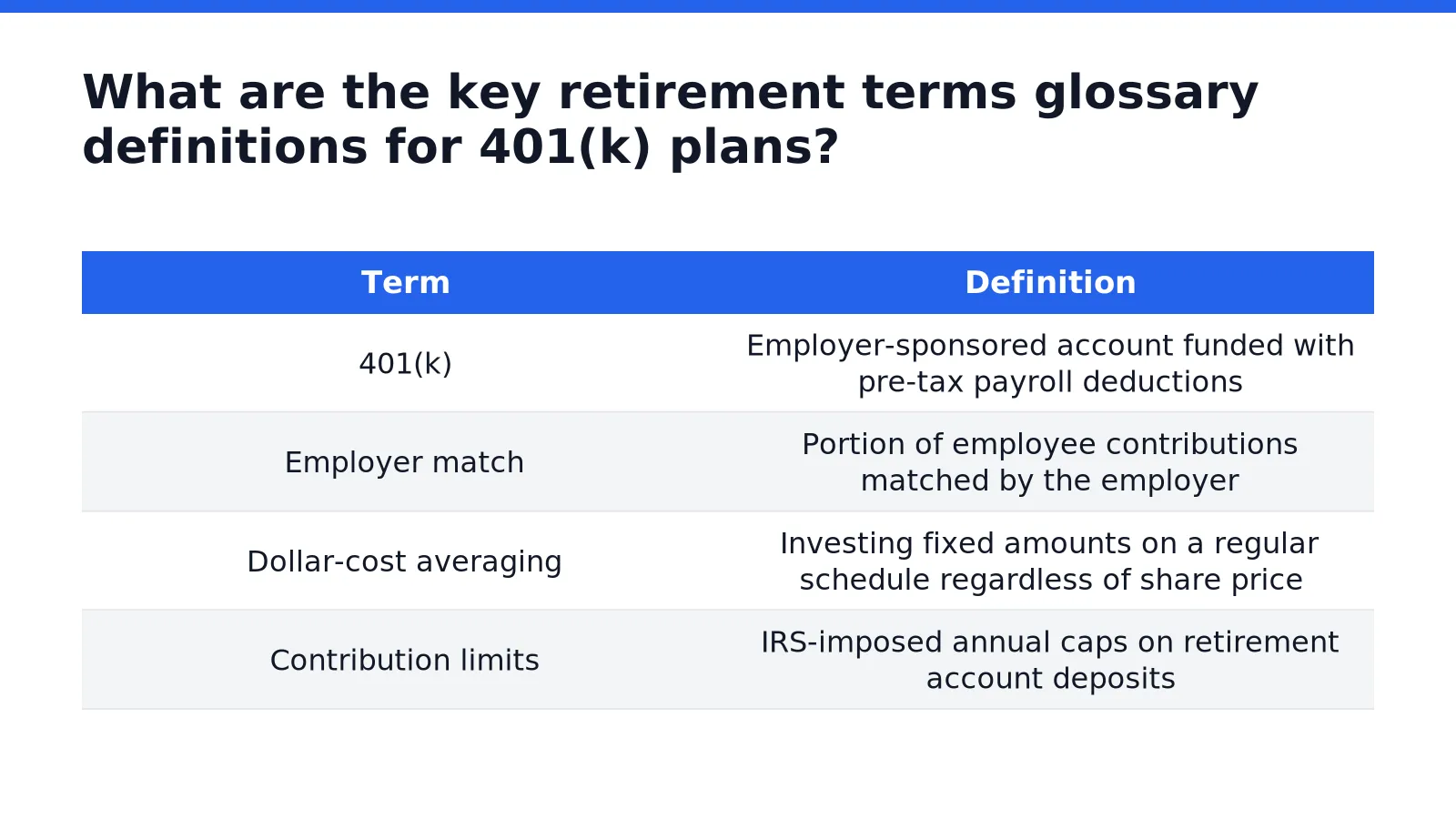
A retirement terms glossary for 401(k) plans starts with the account itself. A 401(k) is an employer-sponsored retirement account where employees direct a percentage of each paycheck into an investment account. These contributions typically come from pre-tax income, which reduces taxable income for the year. EP Wealth Advisors describes the 401(k) as one of the most common types of employer-sponsored retirement accounts.
Employer matching adds another layer to the financial planning glossary. Some employers match a portion of their employees’ contributions, effectively providing additional compensation toward retirement. Contribution limits are set by the IRS and updated periodically. The IRS caps how much individuals can set aside in these accounts per year. Those limits vary depending on the account type and the saver’s age.
How does dollar-cost averaging work inside a 401(k)?
Dollar-cost averaging is a strategy that involves investing the same amount of money on a periodic schedule, such as monthly. The number of shares purchased fluctuates from month to month, but the amount invested does not. During periods of price declines, the strategy automatically buys more shares than when prices are more expensive. Setting aside money for retirement every paycheck naturally benefits from dollar-cost averaging.
What do contribution limits mean in a retirement planning definitions context?
Contribution limits represent the maximum amount an individual can set aside in a retirement account each year. The IRS establishes these caps, and they vary depending on the kind of account. Limits are updated periodically, so checking the IRS website for the most current figures remains essential. An annuity glossary often references similar periodic payment concepts. Annuities provide specified income at regular intervals rather than accumulation-phase rules.
Understanding these definitions helps pre-retirees evaluate how much to contribute and whether employer matching is available. The retirement glossary for 401(k) plans ultimately centers on consistent contributions, tax advantages, and long-term compounding.
How does the financial planning glossary define asset allocation and compounding?
A financial planning glossary defines asset allocation as the strategy of dividing investments across different asset classes. A retirement terms glossary describes compounding as earning returns on both the original principal and previously accumulated gains.
Asset allocation apportions a portfolio’s assets according to an investor’s goals, risk tolerance, and investment horizon. Many financial professionals believe the mix of asset classes has a greater impact on long-term portfolio results than the performance of any individual investment. This makes allocation decisions far more consequential than chasing last year’s top-performing fund.
What is the difference between asset allocation and investment selection?
Asset allocation determines the broad categories, such as stocks, bonds, and cash reserves, that make up a portfolio. Investment selection picks the specific securities within each category. Allocation sets the blueprint; selection fills in the details.
The distinction matters because allocation drives the majority of a portfolio’s risk and return profile. A poorly allocated portfolio filled with excellent individual investments still exposes a retiree to unnecessary vulnerability.
How does compounding grow retirement savings over time?
Compounding generates earnings on previously earned returns, not just the initial deposit. This is defined as earning money on a principal investment and its accumulated interest, typically calculated monthly or yearly.
The mechanism rewards patience. Each period’s gains become part of the base that produces the next period’s growth. Over decades, this cycle transforms modest, consistent contributions into substantial balances. Missing early years of compounding creates a shortfall that larger later contributions struggle to close.
Jacobs Financial Services helps clients understand how market sentiment impacts their financial future. Recognizing the relationship between allocation discipline and compounding patience forms the foundation for protecting a portfolio from early losses. An annuity glossary often references these same principles when explaining how guaranteed income products fit within a broader allocation framework.
What does the annuity glossary say about income stability?
An annuity glossary defines income stability as a specified income payable at regular, stated intervals. This payment structure often continues for the remainder of a recipient’s life. An annuity provides predictable, recurring payments rather than a single lump sum. Without this contractual guarantee, retirees face the risk of outliving their assets during extended market downturns.
How does an annuity protect against market risk?
Jacobs Financial Services emphasizes protection from market risk to keep retirement income safe. A properly structured annuity shields accumulated savings from the losses that volatile markets inflict on unprotected portfolios. Retirees are increasingly exposed to unnecessary risk in volatile markets, a concern that grows as traditional growth strategies fail to account for sequence-of-returns risk during the distribution phase.
What role does investor sentiment play in retirement stability?
The Fear & Greed Index tracks investor sentiment on a scale from 0 to 100. Extreme fear registers at 0 to 24, while extreme greed falls between 76 and 100. When fear dominates, retirees without guaranteed income sources often sell assets at depressed prices, locking in permanent losses. An annuity removes this emotional decision-making from the equation by delivering consistent payments regardless of market conditions.
Understanding these retirement planning definitions helps pre-retirees evaluate whether their current strategy addresses both market and longevity risks. Many common assumptions about annuities do not hold up under scrutiny, particularly the belief that they offer insufficient flexibility. The reality of annuity myths often surprises those who investigate the contractual guarantees these instruments provide. A thorough financial planning glossary reveals that income stability depends less on chasing returns and more on securing predictable cash flow for essential expenses.
How can retirement planning definitions help with tax-efficient withdrawals?
Retirement planning definitions clarify the mechanics of tax-efficient withdrawals, helping retirees preserve more of their savings. Without precise terminology, retirees risk triggering unnecessary tax liabilities that erode long-term income. Understanding the language of tax strategy transforms guesswork into deliberate, dollar-saving decisions.
A foundational term in this process is adjusted gross income, an interim calculation used in computing income tax liability. Retirees who grasp how withdrawals from different account types affect adjusted gross income make smarter sequencing choices. The financial planning glossary further equips individuals to identify which accounts generate taxable events and which do not.
Which retirement accounts trigger the most tax when withdrawing funds?
Tax-deferred accounts like traditional 401(k)s and IRAs create ordinary income tax obligations with every distribution. Roth accounts, by contrast, deliver tax-free withdrawals when certain conditions are met. Knowing these distinctions prevents retirees from inadvertently pushing themselves into a higher tax bracket.
What is the first step in building a tax-efficient withdrawal plan?
The first step is understanding how tax-efficient withdrawal strategies reduce substantial tax burdens that many retirees face. The Jacobs Retirement Roadmap™ structures this analysis so withdrawals align with current tax law and personal income thresholds. Retirees can explore tax-efficient retirement income strategies that prioritize long-term preservation over short-term convenience.
Tax efficiency also requires familiarity with the annuity glossary when annuities form part of the income mix. Annuity payouts carry distinct tax treatment, often blending return of principal with taxable earnings. A comprehensive retirement terms glossary transforms these rules from abstract concepts into actionable withdrawal sequencing. The outcome is straightforward: more money stays invested and less flows to the IRS.
FAQ
What is a 401(k) plan?
A 401(k) is an employer-sponsored retirement account funded with pre-tax payroll deductions, subject to IRS-set contribution limits.
How does employer matching work?
Employer matching provides additional compensation toward retirement contributions by matching a portion of an employee’s contributions.
What is asset allocation?
Asset allocation distributes investments across asset classes to manage risk and align with retirement goals, driving most of a portfolio’s risk and return.
Conclusion
Understanding these retirement planning definitions transforms financial terminology into a practical tool for protecting your future. You now possess the vocabulary to evaluate how compounding, guaranteed income, and tax-efficient withdrawals work together in a cohesive strategy. This knowledge empowers you to ask better questions and make informed decisions about securing predictable cash flow that lasts throughout retirement.