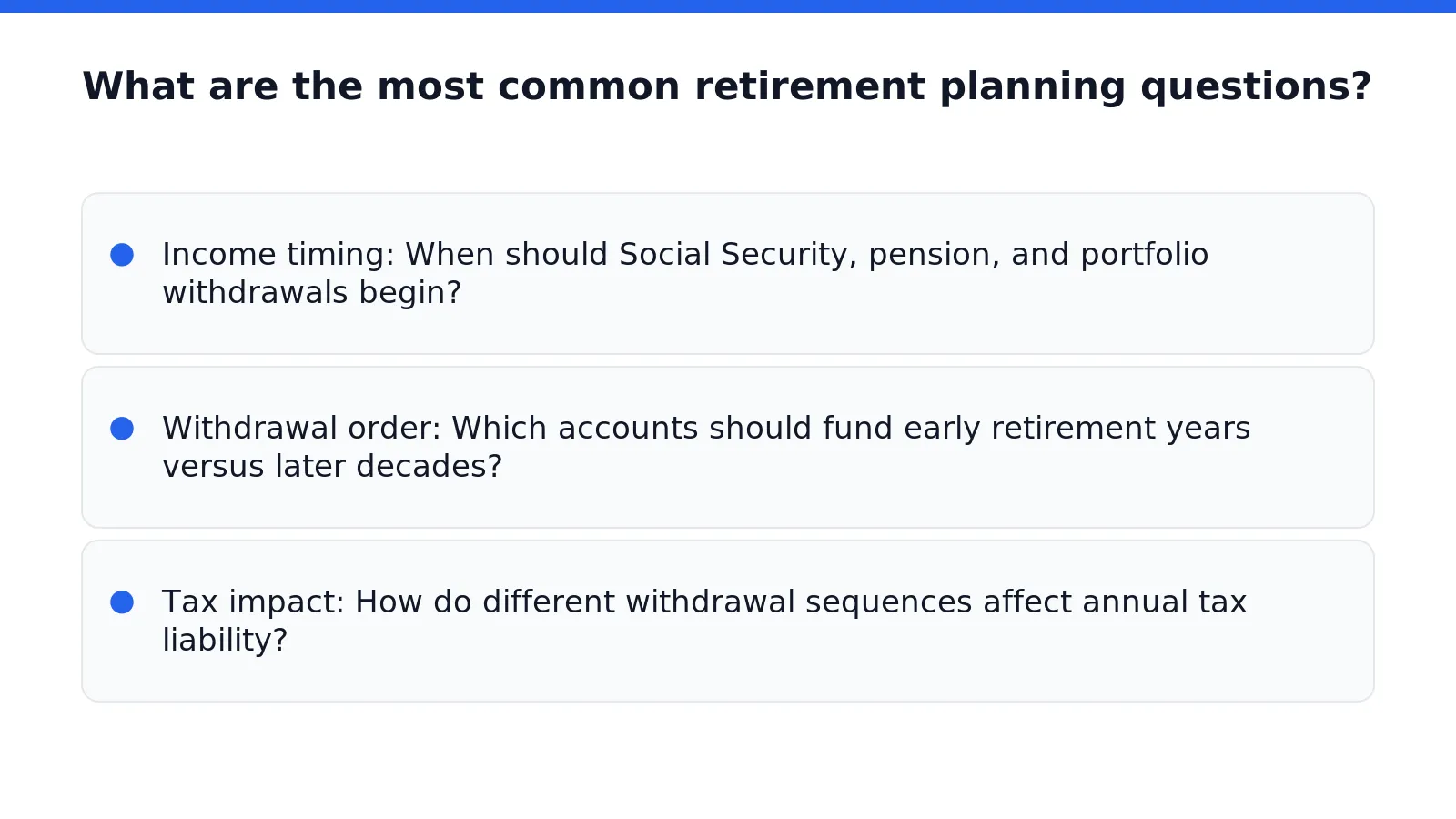


When it comes to retirement planning steps, planning a retirement journey begins with calculating the exact savings needed, a step only half of Americans complete. The average retiree spends roughly 19 years in retirement, requiring protection from market risk and inflation. Jacobs Financial Services develops personalized strategies for clients, prioritizing security and legacy planning.
Key Takeaways
- Only about half of Americans have calculated how much they need to save for retirement.
- The average retiree spends 19 years in retirement, requiring protection from market risk and inflation.
- A complete financial inventory of statements, budgets, debts, and pension documents eliminates guesswork.
- Annual reviews of income projections catch drift before small gaps become shortfalls.
What do you need before starting retirement planning?
A clear picture of current finances and future needs forms the foundation of any retirement planning guide for beginners. The U.S. Department of Labor reports that only about half of Americans have calculated how much they need to save for retirement. Without that calculation, a retiree risks outliving savings during a retirement that the same source notes averages roughly 19 years.
Jacobs Financial Services specializes in helping individuals who are recently retired or preparing to take that step. The company’s approach begins with gathering specific documents and answering hard questions before any strategy takes shape.
What documents should someone gather first?
A complete financial inventory eliminates guesswork. The following items provide the raw data every retirement checklist needs:
- Recent statements for all 401(k), IRA, and brokerage accounts
- Social Security benefit estimates from the Social Security Administration
- Current household budget showing monthly income and expenses
- Outstanding debt balances including mortgage, auto loans, and credit cards
- Employer pension or deferred compensation plan documents
How does someone estimate retirement expenses?
Realistic expense projections prevent unpleasant surprises later. Housing, healthcare, food, and transportation costs shift in retirement, and many pre-retirees underestimate medical expenses. A detailed step by step retirement planning process compares current spending against anticipated post-work costs, then adjusts for inflation over that 19-year average retirement span.
Jacobs Financial Services guides clients through this analysis as part of its essential retirement planning framework. The company focuses on protection from market risk and inflation-fighting strategies rather than growth-at-any-cost approaches. Understanding how to plan retirement starts with knowing exactly where one stands today. The retirement planning steps that follow depend entirely on the accuracy of this initial assessment.

How do you set a realistic retirement savings goal?
A realistic retirement savings goal starts with a clear vision of desired retirement living. Having a clear vision helps set a concrete goal for retirement. Without a defined target, pre-retirees risk undershooting their savings by hundreds of thousands of dollars, leaving decades of retirement underfunded.
What factors determine how much retirement savings is enough?
Two primary factors shape the savings target. First, estimated retirement expenses provide the spending baseline. Second, the number of years savings must generate income determines the total required. The average American spends roughly 19 years in retirement, according to the Department of Labor. A longer retirement demands a larger nest egg to avoid depleting funds prematurely.
How does market risk affect retirement savings goals?
Market volatility threatens retirement income when withdrawals coincide with downturns. Jacobs Financial Services helps clients protect their retirement income from market volatility. A retirement checklist that accounts for sequence-of-returns risk prevents retirees from locking in losses during the critical early withdrawal years. The company’s approach to defining achievable retirement dreams integrates protection strategies that keep savings intact regardless of market conditions.
Setting the goal requires translating lifestyle vision into concrete numbers. A step by step retirement planning process begins with cataloging essential and discretionary expenses, then multiplies annual needs by the expected retirement duration. This calculation reveals the savings target and exposes gaps before they become crises.
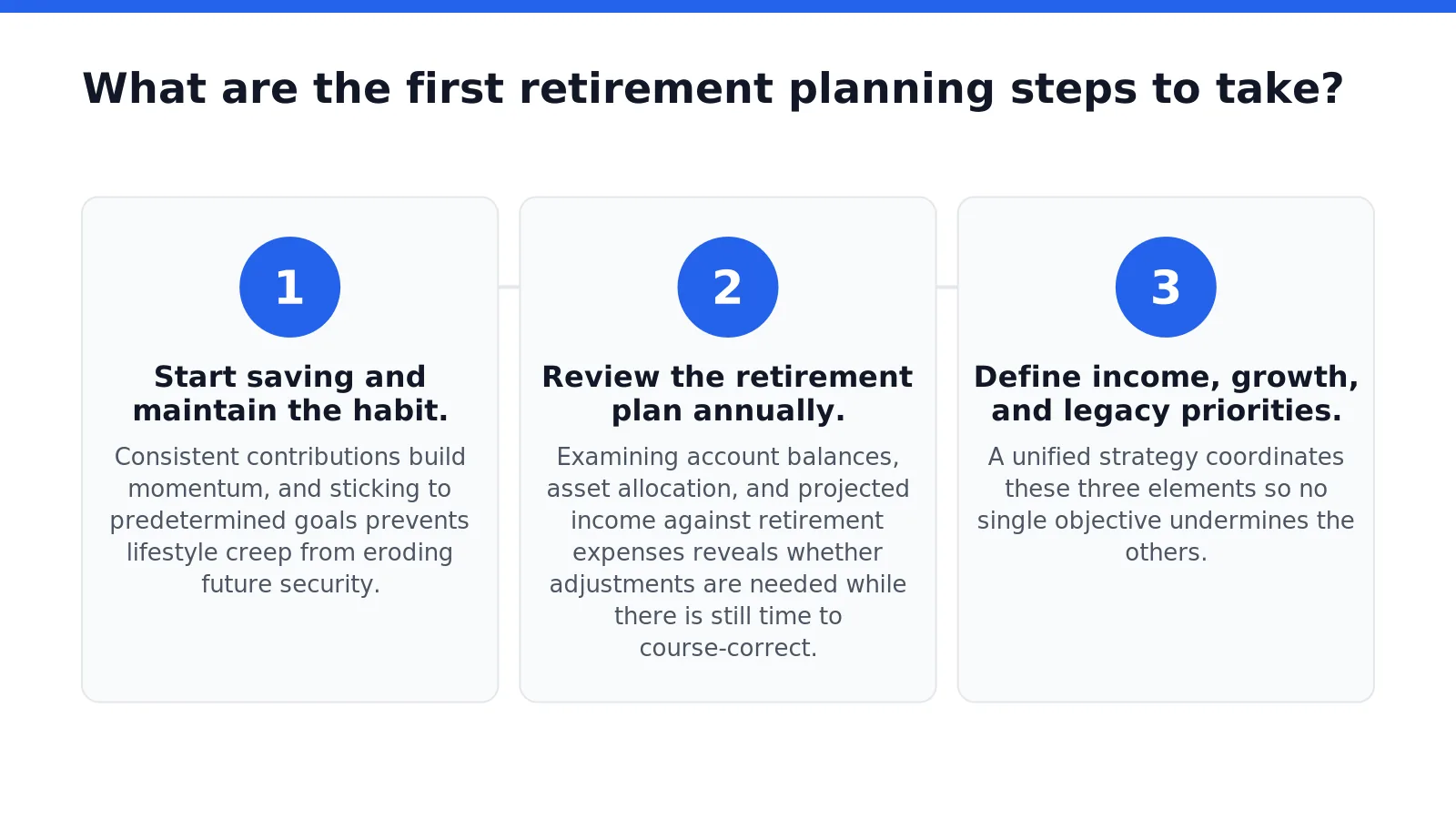
What are the first retirement planning steps to take?
A clear retirement checklist begins with honest self-assessment and consistent saving habits. The U.S. Department of Labor reports that only about half of Americans have calculated how much they need to save for retirement, leaving millions unprepared for a retirement lasting roughly 19 years on average.
How does someone determine their retirement readiness?
Reviewing the current plan at least once a year keeps the strategy aligned with evolving goals, while monitoring asset allocation quarterly. Income projections need regular examination to confirm they still fit the desired retirement timeline. Annual plan reviews catch drift before small gaps become irreversible shortfalls.
The first concrete actions follow a logical sequence:
- Start saving and maintain the habit. Consistent contributions build momentum, and sticking to predetermined goals prevents lifestyle creep from eroding future security.
- Review the retirement plan annually. Examining account balances, asset allocation, and projected income against retirement expenses reveals whether adjustments are needed while there is still time to course-correct.
- Define income, growth, and legacy priorities. A unified strategy coordinates these three elements so no single objective undermines the others.
At Jacobs Financial Services, we take a different approach: Protection from market risk, Inflation-fighting strategies, and Legacy planning. This approach helps pre-retirees assess true readiness rather than relying on guesswork.
What questions should someone ask before retiring?
Asking the right questions before leaving the workforce prevents costly mistakes. A step by step retirement planning approach examines current savings, projected expenses, and income sources such as Social Security and workplace plans. Comprehensive retirement planning steps for financial security include estimating retirement length and testing withdrawal assumptions against realistic market conditions.
How can you protect your savings from market risk?
Protecting retirement savings from market risk requires a deliberate shift away from growth-focused strategies toward preservation. Jacobs Financial Services prioritizes protection from market risk so hard-earned money stays safe, a cornerstone of effective retirement planning steps.
Market sentiment swings between extremes, and retirees cannot afford to ride out every downturn. The Fear & Greed Index tracks investor sentiment on a scale from 0 to 100, helping identify whether markets are driven by fear or greed. When greed pushes valuations unsustainably high, the subsequent correction erodes principal that retirees lack the time to rebuild.
What strategies shield retirement accounts from downturns?
Several approaches reduce exposure to market volatility without abandoning growth entirely. Jacobs Financial Services structures portfolios to limit downside risk while maintaining enough upside potential to combat rising costs. Inflation-fighting strategies ensure purchasing power stays strong over a retirement that may span two decades or more.
A practical retirement checklist for market protection includes these steps:
- Shift a portion of assets into vehicles with principal guarantees
- Reduce equity exposure as the retirement date approaches
- Establish a cash reserve covering two to three years of expenses
- Review asset allocation quarterly
How does market volatility affect retirement income differently?
Losses during retirement inflict greater damage than losses during working years. When withdrawals coincide with market declines, the portfolio loses the ability to recover through future contributions. This sequence-of-returns risk turns temporary downturns into permanent shortfalls. A strategy to protect retirement savings from market volatility addresses this timing challenge directly.
Jacobs Financial Services builds step by step retirement planning frameworks that account for withdrawal sequencing. The goal is straightforward: preserve enough capital to fund essential expenses regardless of what markets do next.
How do you create a tax-smart withdrawal plan?
A tax-smart withdrawal plan preserves retirement savings by controlling when and how funds leave different accounts. Without a deliberate sequence, retirees lose more income to taxes than necessary, shrinking the portfolio that supports decades of living expenses.
The foundation rests on a retirement checklist that maps every account type to its tax treatment. Tax-deferred accounts like traditional IRAs and 401(k)s generate ordinary income when funds are withdrawn. Tax-free accounts such as Roth IRAs deliver withdrawals without triggering a tax bill. Taxable brokerage accounts produce capital gains, often at lower rates than ordinary income. Mixing these sources strategically reduces the total tax burden each year.
What account types should retirees tap first?
A common step by step retirement planning approach begins with taxable accounts, then tax-deferred accounts, and finally tax-free Roth assets. This sequence allows tax-advantaged accounts more time to compound while managing the retiree’s annual tax bracket. The order shifts when a retiree faces a low-income year, making it advantageous to withdraw from tax-deferred accounts or execute a Roth conversion at a lower marginal rate.
How do Roth conversions fit into a withdrawal plan?
Roth conversions move funds from tax-deferred accounts into Roth IRAs, creating a tax bill in the conversion year but eliminating future taxes on those dollars. The strategy works best in years when a retiree’s income dips below typical levels. Jacobs Financial Services emphasizes that minimizing taxes on retirement withdrawals is essential for preserving hard-earned savings and maximizing income during retirement. Converting too much in a single year pushes the retiree into a higher bracket. Partial conversions spread across several low-income years produce better results.
A retirement planning guide for beginners highlights that planning for taxes ahead of time requires using a mix of account types. Roth conversions deserve careful evaluation only after weighing the tradeoffs, including the immediate tax cost against decades of tax-free growth. The company’s guidance on minimizing taxes on retirement withdrawals walks through these calculations in detail.
Required minimum distributions add another layer to the how to plan retirement puzzle. Once a retiree reaches the applicable age, the IRS mandates withdrawals from tax-deferred accounts. Failing to take RMDs triggers a penalty that reduces the amount available for retirement. A tax-smart plan accounts for these mandatory distributions early, using them to cover living expenses before tapping other sources.
FAQ
What documents should I gather before starting retirement planning?
Recent statements for all 401(k), IRA, and brokerage accounts, Social Security benefit estimates, a current household budget, outstanding debt balances, and employer pension documents.
How do I estimate my retirement expenses?
Compare current spending against anticipated post-work costs, then adjust for inflation over the average 19-year retirement span, including underestimated medical expenses.
How do I set a realistic retirement savings goal?
Start with a clear vision of desired retirement living, then calculate the exact savings needed, a step only half of Americans complete.
Conclusion
Planning your retirement journey begins with asking the right questions and building a strategy that protects what you have saved. A deliberate approach to market risk, tax-smart withdrawals, and inflation protection turns uncertainty into confidence. Take the next step by reviewing your current plan against these principles, ensuring your retirement delivers the security and freedom you deserve.